 CAD
CAD
 USD
USD

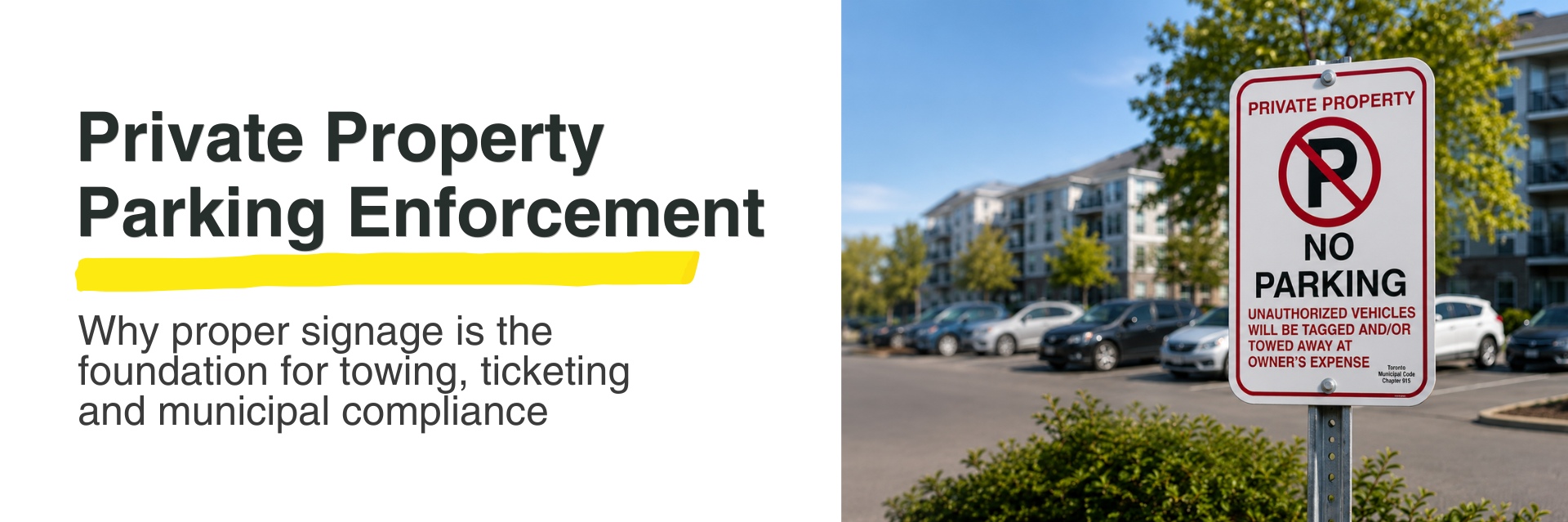
How Private Property Parking Enforcement Works in Ontario
Posted by Safety Media Inc. on 2026 May 26th
How Private Property Parking Enforcement Works in Ontario — and Why Signage Is the Foundation
If you manage a condominium, apartment building, commercial plaza, place of gathering, office property, industrial site, or private parking lot in Ontario, you have likely dealt with unauthorized vehicles, tenant or visitor parking disputes, blocked access areas, or the frustration of calling a towing company only to be told they cannot act. In many cases, private property parking enforcement fails because of one foundational issue: signage.
Here is how private property parking enforcement works — and what your property needs before any of it can begin.
Talk to a Parking Signage Specialist
In this guide:
Enforcement on Private Property Is Not Automatic
Unlike public roads, where municipal parking by-laws apply by default, private property parking is governed by a different set of rules. On private property, the owner or authorized property manager controls who may park and under what conditions. But that control only becomes enforceable when it is clearly communicated. That is where signage comes in.
This is the principle behind private property parking legislation. Municipalities do not send officers to patrol private lots by default. Enforcement happens when a property owner or manager requests it, and it is only possible when proper signage is in place.
Key point: Without properly posted signs, there is no enforceable rule — even if the parking restriction is obvious, understood by tenants, or written into a lease.
The Role of Signage Under Municipal By-Laws
Every municipality handles private property parking enforcement slightly differently. Some municipalities require very specific sign wording, sizes, by-law references, entrance signage, or approval before enforcement can begin. Others focus on whether signs clearly state the parking conditions and give drivers reasonable notice before they park.
The important point is this: posted signage is the foundation of private property parking enforcement.
| Municipality | Private Property Parking Signage Context |
|---|---|
| Toronto Toronto Chapter 915 |
Under Municipal Code Chapter 915, parking on private property without the owner’s or occupant’s consent is prohibited. The code specifically recognizes posted signs with a reference to Chapter 915 as the mechanism for establishing and communicating parking conditions. Without properly posted signs, there may be no clear posted condition for enforcement under the by-law. |
| Mississauga Private Property Enforcement Traffic By-law 0555-2000 |
Traffic By-law 0555-2000 governs parking on private property. The City's enforcement process states clearly that every private property must have proper signs outlining parking regulations before the City will enforce posted rules. |
| Oakville Sample Private Property Parking Sign Delegated Authority Form |
By-law 1981-65 addresses parking on private property without consent, while By-law 2024-187 addresses towing without the vehicle owner’s consent. Oakville requires proper signage to be in place before any enforcement action can be initiated. |
| Vaughan Parking By-law 064-2019 |
Parking By-law 064-2019, Section 8.0, addresses private property parking directly. Under this by-law, vehicles parked contrary to conditions posted on a sign may be deemed parked without consent — making the posted sign the legal trigger for enforcement. |
| Markham Parking Control By-law 2005-188 |
Parking Control By-law 2005-188 includes provisions for private property parking where signs are posted stating conditions or prohibiting parking. The sign is what communicates the restriction to the driver. |
| Richmond Hill Municipal Code Chapter 1116 |
Municipal Code Chapter 1116 regulates parking on private property where conditions are posted. It makes the signage the required foundation for any enforcement action. |
| Brampton Parking Offences |
Unauthorized Parking By-law 104-2018 governs private property parking enforcement. The City's process requires proper signage to be in place before staff will respond to complaints. |
| Pickering Traffic and Parking By-law 6604/05 |
Traffic and Parking By-law 6604/05 addresses parking on private property and requires posted signage to support parking control enforcement. |
| Oshawa Parking on Private Property |
Traffic and Parking By-law 79-99 regulates parking on municipal and private property, including parking on private property without consent. Oshawa requires signs at each entrance and within the authorized parking area, clearly indicating the parking regulation. Oshawa’s Unauthorized Parking By-law 97-2009 separately prohibits parking in unauthorized areas and may also be relevant depending on the parking issue. |
| Whitby Private Parking By-law 2916-90 |
Private Parking By-law 2916-90 prohibits parking on private property without the owner’s or occupant’s consent. Posted signage helps establish that consent has been withheld. |
| Burlington Authorization Sign Requirements |
Burlington’s private property enforcement process requires authorization signs before enforcement. The City’s authorization sign guidance states that mandatory private property signs must be installed at every entrance to the property. |
| Halton Hills By-law 2005-0117 |
By-law 2005-0117, Part IV addresses parking on private property and requires proper signage before enforcement can be initiated. |
Not every municipality uses the same wording or requires the same by-law reference on the sign. Some municipalities clearly require or provide specific sign formats, while others rely on posted conditions that clearly communicate parking rules. This is why sign wording, placement, size, visibility, and municipal references should be reviewed before signs are manufactured or installed.
Accessible Parking — A Different Set of Rules
Accessible parking on private property is governed differently than general parking restrictions. In Ontario, accessible parking enforcement falls under the Highway Traffic Act rather than municipal by-laws. This means the enforcement mechanism, the authority to issue a ticket, and the signage requirements are all distinct from standard private property parking rules.
Property managers responsible for accessible spaces should ensure those spaces are signed in accordance with provincial requirements and understand that municipal enforcement officers may not have jurisdiction to act on accessible parking violations on private property. A separate process applies.
How to Actually Authorize a Tow
Having proper signs in place is the foundation — but property managers also need to understand how towing authorization works in practice. Most properties establish a standing agreement with a licensed towing company, which authorizes them to patrol the property and remove vehicles that violate posted conditions without requiring the property manager to be present for every tow. Under Ontario’s Towing and Storage Safety and Enforcement Act framework, towing companies must be licensed, and the posted signage on your property serves as the documented authorization for their actions.
Before entering into a towing agreement, confirm that your towing company is TSSEA-licensed and that your signage meets the requirements they need to act.
What Makes a Sign Enforceable
Posting any sign is not enough. Municipal enforcement programs and towing operators look for signage that meets specific requirements, which can include:
Correct Wording
Many municipalities specify or recognize particular language. Signs should clearly communicate who may park, when parking is allowed, and what happens if the posted conditions are violated.
By-Law Reference
Some municipalities require or recommend the applicable by-law number to appear on the sign.
Proper Placement
Signs are often required be posted at entrances and at intervals throughout the parking area so drivers have reasonable notice before parking.
Visibility
Signs must be readable in the conditions where enforcement takes place, which may require reflective backgrounds for nighttime enforcement.
Correct Size
Undersized signs may not meet visibility or municipal requirements.
A sign that is missing one of these five elements may not be sufficient to support enforcement, even if it is posted in the right location.
Who Pays When a Vehicle Is Towed — and What Happens in a Dispute
When a vehicle is towed from private property in Ontario, the towing and storage fees are the responsibility of the vehicle owner — not the property owner. The property owner authorizes the tow but does not bear the cost. Ontario’s TSSEA regulates towing rates and establishes consumer protections for vehicle owners retrieving their vehicles.
If a vehicle owner disputes the tow, properly posted and compliant signage is your primary protection. A dispute is difficult to sustain when signs were clearly visible at every entrance and throughout the property, contained the correct wording and by-law reference, and met municipal requirements. Without compliant signage, that protection disappears — and both the property owner and the towing company can be exposed to liability.
What Happens Without Proper Signage
Property managers who call for towing without compliant signage in place often find that the towing company declines to act because removing a vehicle without proper posted authorization exposes the towing operator to liability.
Municipal enforcement officers face the same constraint: without compliant signs, there may be no clear posted rule to act on.
The result is that unauthorized parking continues, tenant frustration grows, and property managers are left without recourse — not because enforcement is unavailable, but because the legal foundation for it has not been established.
Most properties we assess are missing at least one sign required for enforcement. In some cases, signs are present but do not meet current municipal requirements, are placed incorrectly or lack required by-law references.
Getting It Right
Private property parking enforcement is straightforward when the right signage is in place. The signs communicate the rules, establish the legal basis for enforcement, and protect property owners and towing operators when action is taken.
Through our Private Property Parking Signage Solutions, Safety Media manages parking signage projects from initial assessment through final installation — so you are never left figuring it out on your own.
- Property assessment — we review your property layout, entrances, parking areas, existing signs, and enforcement challenges.
- Compliance review — we help confirm applicable municipal requirements, by-law wording, size, visibility, and placement needs.
- Sign selection — we recommend the right mix of authorized parking, visitor parking, tenant parking, permit parking, no parking, tow-away, accessible, loading, and fire route signs.
- Custom wording and by-law references — we can add municipality-specific wording and by-law references to most standard sign formats.
- Professional installation — Safety Media can support sign placement, posts, hardware, mounting, spacing, and coordination of underground utility locates where required.
- Full signage packages for new developments — we support properties setting up parking control programs for the first time.
- Updates for existing properties — we help replace outdated, missing, damaged, or unclear signs.
Standard signs ship within 1–2 business days. Custom signs, including signs requiring specific municipal by-law references, are typically manufactured within the same window.
If you are unsure whether your current signage meets your municipality's requirements — or if you are setting up a parking control program for the first time — a property assessment can identify exactly what is required and what is missing.
Contact Safety Media — Get a Parking Signage Assessment
Frequently Asked Questions
What signs do I actually need for my property?
It depends on your property type, how your parking area is organized, and what problems you are trying to solve. A condominium with assigned tenant parking, visitor spots, accessible spaces, and fire routes needs a different combination of signs than a commercial plaza, office property, apartment building, or private lot. Common sign types include Authorized Parking, No Parking, Visitor Parking, Tenant Parking, Permit Parking, Tow-Away, Reserved Parking, Loading Zone, Accessible Parking, and Fire Route signs. If you are unsure, a property assessment can identify what your property requires and what may currently be missing.
How many signs are required and where should they be placed?
Most municipalities require signs at every entrance to the property and at intervals throughout the parking area. The goal is to ensure that no driver can reasonably claim they were unaware of the restrictions. Spacing and placement matter. Gaps in coverage can be used to challenge enforcement. Safety Media can review your property layout and recommend placement that is consistent, visible and defensible.
What about permit parking — how does that work with signage?
Permit parking systems require signs that clearly identify the parking condition. Depending on the municipality and property type, this may include wording such as Permit Parking Only, Authorized Vehicles Only, Visitor Parking by Permit or instructions for how visitors can obtain a permit. The signage needs to be specific enough that a towing company can act on it without ambiguity. If you are setting up a permit parking program, sign wording and placement should be reviewed carefully to ensure the conditions are clearly communicated and enforceable.
Do parking signs need to be reflective?
Not always. Reflectivity requirements vary by municipality and sign type. However, reflective backgrounds significantly improve visibility in low-light conditions and are recommended for properties where enforcement takes place after dark. If your towing company operates at night, your municipality conducts evening patrols, or your property has poor lighting, reflective signs help ensure the posted conditions are clearly readable. We supply both standard and reflective options.
What size should private property parking signs be?
Safety Media supplies private property parking signs in two standard sizes: 12" × 18" and 18" × 24". Larger signs are more visible at a distance and are generally recommended for high-traffic areas, wide entrances, and properties where drivers approach at speed. Smaller signs can work well in tighter spaces, underground parking, and areas with slower traffic. Safety Media can help you choose the right size for each location on your property.
Does the sign need to reference a specific by-law?
In many GTA and larger municipalities, a by-law reference is required, recommended or commonly used. Some by-laws specifically require or recognize signs that include the applicable by-law number, and towing operators often request it before acting. Including the correct by-law reference on your signs can strengthen the legal foundation for enforcement and reduce the risk of a successful dispute. Safety Media includes municipal by-law references at no additional cost for most standard private property parking sign formats.
Can I customize the wording on a parking sign?
Yes. If your property requires specific wording beyond what is available in standard stock, custom signs are available. Adding a municipal by-law reference to a standard sign is done at no additional cost for most standard formats. Other custom wording, layouts, or configurations are available upon request and priced accordingly.
What happens if my signs do not meet municipal requirements?
Municipal enforcement officers may decline to act, and towing companies may refuse to remove vehicles without proper posted authorization. If a tow does proceed and the vehicle owner disputes it, non-compliant signage can significantly weaken your position. Signs that do not meet requirements may create the appearance of enforcement without the legal foundation to back it up.
Do I need to notify tenants before implementing or changing parking rules?
This is an important step that property managers sometimes overlook. While the specific notice requirements depend on the terms of your lease agreements, condominium rules, property policies, and applicable legislation, best practice is to provide written notice before new parking rules are enforced. Clear communication upfront reduces disputes, improves compliance, and demonstrates that rules were applied fairly. Signage establishes the posted condition for enforcement — tenant notification supports it.
What about seasonal parking rules — can signs accommodate temporary restrictions?
Yes. Many properties have seasonal requirements such as snow removal periods, overnight winter parking restrictions, temporary construction zones, or reserved areas during construction. These can be addressed through supplementary signage posted for the relevant period alongside permanent signage. If your property has recurring seasonal restrictions, it is worth planning signage in advance so enforcement is not delayed when the season begins.
Do you install the signs or just supply them?
Both. Safety Media provides a full set of private property parking signage solutions for property managers. We can supply signs only, or manage the entire project from assessment through installation. Our installation service includes proper post-setting, sign placement and spacing, mounting hardware, and coordination of underground utility locates where excavation is required. We work with new developments setting up parking control programs for the first time and with existing properties that need to update or expand their signage.
When should I review and update my existing signage?
Signage should be reviewed when your municipality updates its parking by-laws, when your property adds or reconfigures parking areas, when a towing company or municipal enforcement officer identifies a compliance gap, or when enforcement actions are being successfully disputed. As a general practice, an annual review of your posted signage against current municipal requirements helps ensure your parking controls remain valid and enforceable. If your signs are several years old or your property has changed, a fresh assessment is worth arranging.
What if I am not sure what my property is missing?
This is one of the most common situations we encounter. Most properties we assess are missing at least one sign required for enforcement — and many have signs that are present but incorrectly placed, outdated or missing required by-law references. A property assessment by Safety Media can identify what is in place, what is missing and what is needed to bring your property into compliance.
Need Help Choosing the Right Parking Signs?
Every property is different. The right private property parking signage depends on your municipality, parking layout, enforcement process, visibility needs, and the type of parking rules you need to communicate.
Safety Media can help review your current signage, identify what should be confirmed, and manufacture durable parking signs for your property.
Explore our Private Property Parking Signs — standard and custom parking signage solutions designed for real-world use across Ontario properties.